Home › Concrete Slab Installation
Superior Concrete Detroit installs concrete slab foundations for garages, sheds, home additions, and patios. We handle site prep, base stone, reinforcement, and precise leveling. Our concrete floor slabs are engineered to support your structure and resist cracking. Contact us today to discuss your concrete slab project and get a detailed quote.
Superior Concrete Detroit provides professional concrete slab throughout Detroit, MI, Michigan and the surrounding area. Our licensed, insured crew delivers safe, clean, on-time work with a free estimate before anything begins. Call (313) 986-4241 or request your free quote.
Concrete slab work that fits Detroit properties and weather
Concrete slab projects in Detroit are not all the same. A backyard patio, a garage floor, and a machine pad in a small shop each have different loads, thickness needs, and finish requirements. At Superior Concrete Detroit, we start by asking how the slab will be used, what will sit on it, and how you want it to look months and years from now.
Detroit’s freeze and thaw cycles are hard on concrete. If the base is too thin, the mix is wrong, or control joints are skipped, slabs crack early and shift. We design every concrete slab to handle local soil conditions, road salt tracked in from winter streets, and temperature swings from January through July.
Instead of pushing a one size fits all package, we look at site drainage, access for trucks, and how close the slab will be to foundations or property lines. That lets us recommend the right thickness, reinforcement, and finish so you are not paying for overkill, but you are not left with a weak slab either.
How we prepare the site and subgrade so the slab does not fail
Most slab problems start below the concrete, not in it. Superior Concrete Detroit spends more time on preparation than most people ever see, because this is what keeps your slab from heaving, sinking, or cracking apart.
First, we mark out the slab and call in utility locates as needed, especially in older Detroit neighborhoods where gas or water lines can be shallow or not clearly mapped. We strip sod, roots, and any soft organic material until we are down to firm ground. If the existing soil is spongy, high in clay, or has old fill from past construction, we either remove and replace it or compact it in thin layers with a plate compactor or roller.
Next, we install a compacted base, usually 4 to 8 inches of crushed concrete or limestone, depending on the use of the slab. For driveways, garages, and commercial pads, we lean toward the thicker side. Moisture and compaction are checked so the base is solid but not saturated. When needed, we add a slight slope away from buildings so water does not sit against foundations.
If moisture control is important, for example under interior floors or living spaces, we add a vapor barrier over the base. Around Detroit, this is a key detail many low bid crews skip, and it is a big reason some slabs end up with moisture problems, musty smells, or flooring failures later.
Concrete mix, thickness, and reinforcement options that match real loads
Not every concrete slab should be the same thickness or strength. Superior Concrete Detroit chooses mix designs and reinforcement based on how the slab will be used and how long you plan to use it.
For typical patios and walkways, a 4 inch slab with a 4,000 psi air entrained mix usually works well for our climate. For driveways and garage floors that support vehicles and winter snow loads, we often recommend 5 inches or more and may specify 4,500 psi concrete for added strength and surface durability. Commercial or industrial slabs, especially those supporting equipment or racking, can require 6 inches or thicker, doweled joints, and higher strength mixes.
Reinforcement options include wire mesh, rebar grids, or synthetic fibers in the mix. Mesh and rebar do not stop hairline cracking, but they hold the slab together and help control movement if cracks form. For Detroit garages where heavy trucks or work vans park, we frequently use #3 or #4 rebar on a 12 or 18 inch grid, supported on chairs so it stays centered in the slab instead of sagging to the bottom.
Air entrainment, which creates tiny air pockets in the concrete, is especially important here because it allows water in the concrete to expand during freezing without blowing the surface apart. Using deicing salts is common in Michigan winters, so we factor in surface durability as well. We will explain the differences in clear terms so you understand what you are paying for and what you can expect out of your slab over time.
Forming, pouring, finishing, and jointing your concrete slab
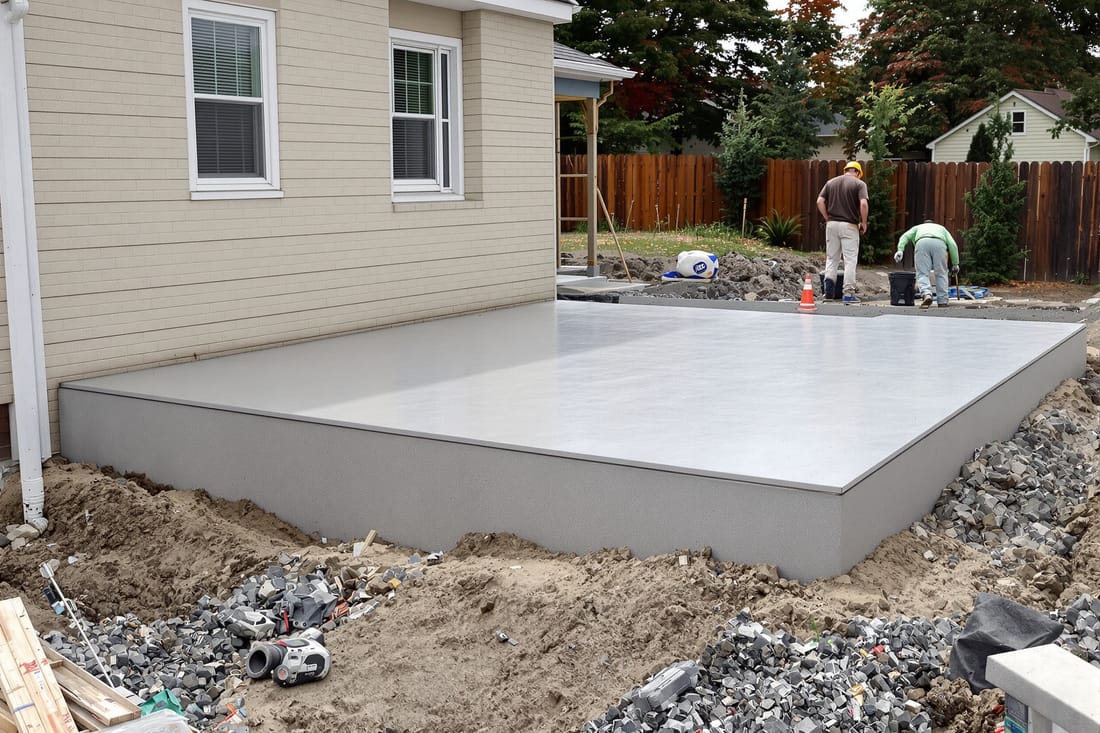
Once the base is ready, we set sturdy forms that define the exact size, shape, and elevation of your slab. Superior Concrete Detroit checks elevations with a laser level, not just by eye, so the slab drains the right way and transitions smoothly to existing surfaces or door thresholds.
Before the truck arrives, reinforcement is placed and tied, vapor barriers are sealed, and any penetrations for plumbing or anchors are set. We schedule pours around Detroit traffic patterns and plant locations so the concrete arrives within its workable time window and is not already starting to set in the drum.
During the pour, our crew places the concrete in layers, avoiding segregation of aggregate, then strikes it off with a screed to reach the proper height. We use bull floats to bring up paste and smooth the surface, then let the concrete start to set before any steel troweling or broom finishing. Rushing this step can trap water at the surface and weaken the top layer, which is why we time it carefully based on temperature, wind, and humidity on that specific day.
Control joints are cut or tooled at planned locations and depths so that if the slab does crack as it shrinks, it does so in a mostly straight line where it is less visible and less damaging. The spacing, usually 8 to 12 feet apart depending on thickness, is not random. We plan it before we pour to avoid awkward lines crossing doorways or high traffic spots.
Dealing with Detroit weather and scheduling your slab project
Concrete work in Detroit is heavily affected by weather, especially temperatures and freeze risk. Superior Concrete Detroit plans projects on a calendar that reflects local conditions, not a generic national schedule.
In the colder months, we pay close attention to forecast lows. If fresh concrete freezes before it gains strength, the surface will scale and flake. For late fall or early spring pours, we may use heated blankets, insulated forms, or cold weather mixes that include accelerators, and we avoid pouring when a rapid freeze is expected that we cannot protect against.
In summer, heat and wind can pull moisture out of the slab too fast, leading to surface cracking or dusting. We adjust by starting earlier in the morning, using curing compounds that hold moisture in, and sometimes modifying the mix to slow down the set. On very hot, windy days, we may recommend rescheduling rather than risking a poor finish.
For homeowners and business owners, this means timing matters. If you are planning a garage slab, parking pad, or large patio, calling ahead lets us align your project with a good weather window. We will also explain how long you should wait before walking or driving on the slab, which can range from 24 hours for light foot traffic to a week or more for vehicles, depending on the specific concrete and conditions.
Costs, common issues, and what to ask before you hire
Concrete slab pricing in Detroit depends mainly on access to the site, slab size and thickness, reinforcement type, and finish details. Removing old concrete, hauling debris through tight alleys, or pumping concrete over fences adds labor and sometimes equipment costs. Superior Concrete Detroit walks the site before final pricing so there are no surprises halfway through the job.
We are open about where you can save and where cutting corners backfires. For example, skimping on base prep or joint cutting is a common mistake that can lead to frost heave, random cracking, and slab movement that is much more expensive to fix later. Upgrading thickness by even one inch in traffic areas is often a better investment than fancy finishes that do nothing for strength.
Before you hire any contractor for concrete slab work, ask who will actually be on site doing the work, how they plan to handle subgrade preparation, what mix and psi they are ordering, how they will place control joints, and what curing method they use. Ask to see recent local projects, not just photos from out of state.
With Superior Concrete Detroit, the crew that shows up is the crew that knows your project. We provide clear, written details of the slab design, including thickness, reinforcement, and finish, so you know exactly what is going into the ground on your property. If you have an existing slab that has cracked or settled, we can also look at what went wrong there and design the new slab to avoid the same issues.